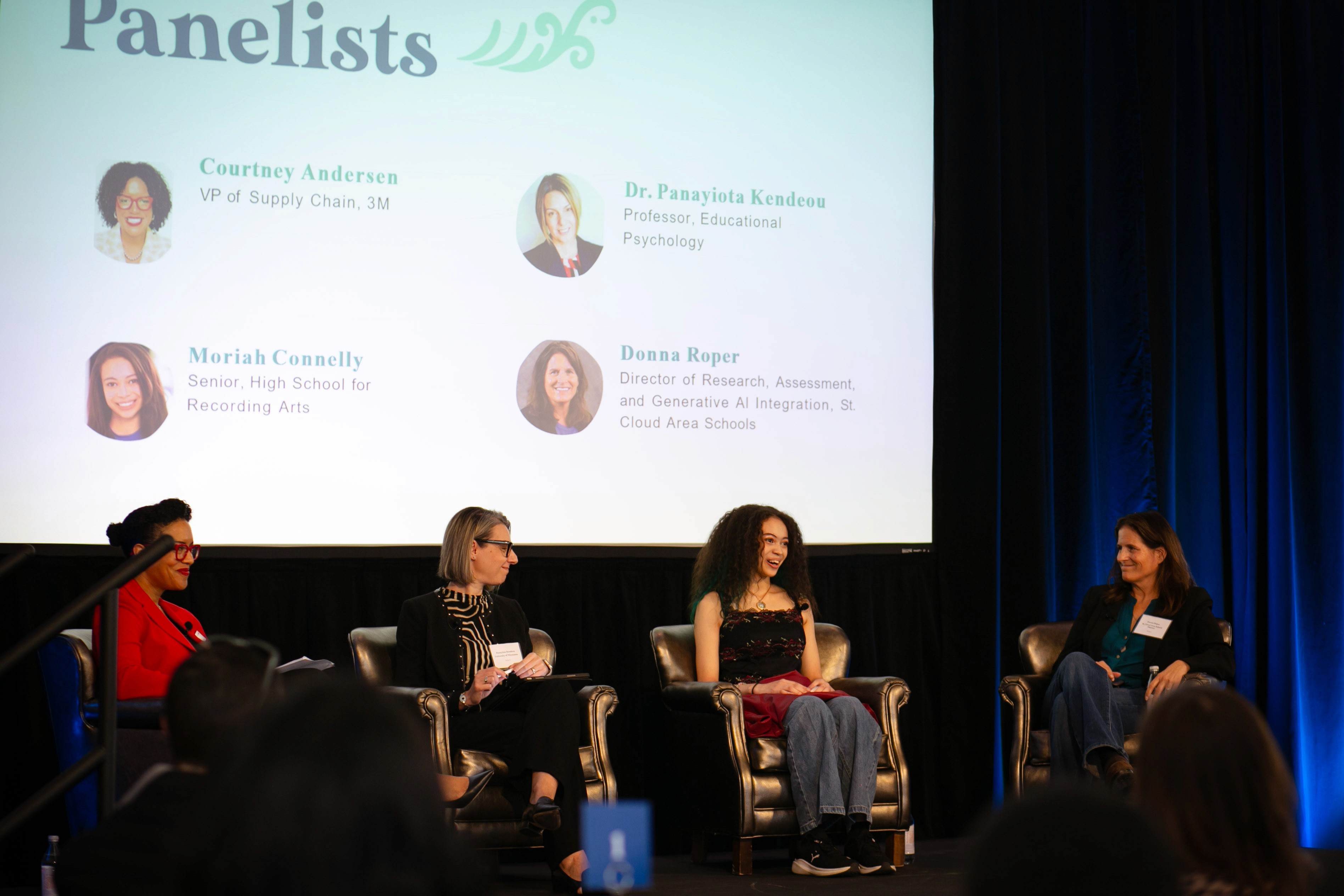
On April 24, World Savvy, in collaboration with 13 other Twin-Cities-based education nonprofits, brought together students, educators, researchers, and community leaders to wrestle with a question that feels increasingly urgent: what does AI actually mean for young people, and what should we do about it now?
From the start, the conversation was grounded in something simple but easy to lose sight of: while technology may be changing classrooms, learning itself is still built on relationships. That idea lingered throughout the morning. AI may expand what is possible, but it does not change the core conditions that make learning real—students feeling known, challenged, and in conversation with others.
Where AI is helping and where it is creating tension
This tension came into sharp focus during the panel conversation moderated by Courtney Anderson and featuring Dr. Panayiota Kendeou, Donna Roper, and Moriah Connelly. Together, they surfaced a core challenge: AI is designed for efficiency, yet learning depends on something slower and more complex.
As Dr. Kendeou noted, the process of struggling through an idea is not a barrier to learning—it is part of it. When AI removes that friction too quickly, it changes how students engage with thinking itself.
That tension is already playing out in classrooms. Students can use AI to deepen their understanding or to bypass it entirely, and from the outside, those two uses can look almost identical.
Moving Beyond “Use It or Ban It”
The panel also made clear that this moment is not about deciding whether AI belongs in schools. Students are already using it.
As Donna Roper put it, “The easy conversations are ‘ban it’ or ‘let everyone use it however they want.’ The hard one is, what is the best way for us to use this to support learning?”
That middle ground—thoughtful, intentional use—is where schools are now operating, often without clear guidance and under real pressure to adapt quickly.
What Students Are Asking
Moriah Connelly, speaking from her experience as a student at High School of the Recording Arts, offered a powerful reminder that when learning becomes overly automated, it is noticeable. It changes how the work feels and how connected students are to it.
Across the day, what stood out was not a lack of awareness but a lack of guidance. Many young people shared that adults rarely engage them in meaningful conversations about AI. When those conversations do happen, they tend to focus on rules rather than the bigger questions students are already asking: when is this helping me think, and when is it replacing my thinking? What are the risks to my privacy, my identity, and my future?
What This Means for Schools
At the same time, educators are navigating these questions within systems that were never designed for this moment.
One shift is already becoming clear. When AI can generate answers, traditional measures of learning begin to lose meaning on their own. This creates both pressure and opportunity to move toward deeper forms of learning, where students demonstrate not just what they know, but how they think and apply that knowledge in real-world contexts.
What Comes Next
What made the gathering distinct was not only what was said on the stage by the panel, but what happened after. Students, educators, and leaders sat together in small groups, working through the implications of AI in real time. The conversations were not polished or performative. They were grounded in lived experience—what people are trying, what is working, what feels uncertain, and what they need now.
This kind of insight is easy to overlook, but it is essential. If we are serious about building education systems that can meet this moment, they cannot be shaped solely by policy or theory.
They must be informed by the people who are navigating these changes every day. What we saw on April 24 was a glimpse of what that can look like: a space where complexity is acknowledged, multiple perspectives are held, and the focus stays where it belongs—on supporting young people to think, connect, and make meaning in a rapidly changing world.